
UHPC’s superior performance data and index
1、The high compactness and good working performance of UHPC make the surface that contacts with the template have a high degree of smoothness. The outside harmful medium is difficult to intrude into the UHPC, and the colorants and other components in the UHPC are not easily dissolved out. With this characteristic, UHPC can be used as the exterior decoration material of buildings, and the chromatic aberration is reduced to the minimum, which is more conducive to surface cleaning.
2、UHPC is a ultra-high strength cement-based material with high strength, high toughness and low porosity. Its basic preparation principle is that by increasing the fineness and activity of the component, without the use of coarse aggregate, the defects (pores and micro cracks) within the material are reduced to the least, so as to obtain ultra high strength and high durability.
3、Mechanical properties of UHPC
Property | Heat-treated Ductal® — FM and Ductal® — AF | Unheat-treated Ductal® — FO |
Apparent density | 2500kg/m³ | 2350kg/m³ |
Compressive strength | 150~180MPa | 100~140MPa |
Bending strength(4×4×16cm) | 30~40MPa | 15~20MPa |
Tensile strength | 8MPa | 5MPa |
Residual tensile strength | 8Mpa | 3MPa |
Young’s modulus of elasticity | 50Gpa | 45Gpa |
Poisson ratio | 0.2 | 0.2 |
Shrink | <10µm/m | <10µm/m |
Creep coefficient | 0.3 | 0.8 |
Coefficient of thermal expansion | 11.8µm/m/°C | 11.8µm/m/°C |
4、Resistance to acid attack. UHPCis exhibiting high resistance, even under severe conditions (the general concrete will be destroyed), and it’s resistance ability can make it be exposed to various erosion elements (such as calcium sulfate, sodium sulphate, acetic acid, ammonium sulphate, nitrate, sea water and distilled water).
5、UHPC is an Ultra High Performance Concrete (UHPC) which is developed from fine and high strength aggregate. The aggregate size combination has been optimized, so it is the lowest porosity concrete in the market. Because Ductal UHPC uses a specific combination of materials, it is suitable for the production of narrow and tiny components and these components have high durability (abrasive resistance, carbonation, chloride permeability and freezing-thawing resistance, etc.), which are far higher than the traditional concrete materials, such as at least 1000 times lower oxygen permeability. The hollowing out rate can be made to 50~70%.
6、The excellent performance of the material itself and the premixed pouring process make the product quality more stable and controllable, and it is not easy to crack.
7、Freeze-thaw test (300 cycles) 100% don’t change
•Ice salt denudation<0.0131b/M2, capillary porosity<1%
•HRT cycles 100%
•Abrasion resistance (relative volume loss index)1.7
•Oxygen permeation<10—9M2, total porosity3-6%
•Carbonization depth<0.02in
8、Way to install: both open installation and concealed installation are acceptable.
UHPC Stone-Look Landscape Flower Bed: A Durable and Architectural Approach to Modern Outdoor Design
Urban landscapes, public plazas, residential courtyards, and commercial outdoor environments increasingly need building materials that balance aesthetics, durability, and long-term stability. Traditional stone has always been valued for its natural appearance, yet it comes with limitations such as heavy weight, susceptibility to weathering, and structural inflexibility. The development of Ultra-High Performance Concrete (UHPC) provides a modern solution that meets these challenges.
The UHPC stone-look landscape flower bed has emerged as an innovative product that blends engineered performance with the beauty of natural stone, offering designers a highly stable, adaptable, and visually refined choice for contemporary outdoor spaces.
UHPC is a composite material known for its dense matrix, extremely low porosity, and superior compressive and flexural strength. Unlike conventional concrete, UHPC is strengthened through carefully selected aggregates, optimized particle packing, and fibers that enhance ductility. These properties allow UHPC elements to be thin yet structurally solid, resistant to cracking, and long-lasting even in demanding environmental conditions.
In landscape architecture, UHPC is used to produce panels, planter walls, paving elements, street furniture, and façade components. Its versatility is a key advantage, as it can replicate various textures, finishes, and natural materials, including the stone-like surfaces required for planter beds.
The stone-look finish is achieved through specialized molds and pigmentation techniques that replicate the texture, grain, and depth of natural rock. This gives UHPC flower beds the appearance of quarried stone without the structural disadvantages. Designers often choose UHPC stone-look elements because they coordinate well with timber, metal, glass, and modern architectural materials.
The aesthetic benefits include:
Realistic stone texture with subtle variations
Enhanced color stability due to UV-resistant pigments
The ability to achieve custom patterns that are difficult with natural stone
A refined appearance suitable for minimalistic and contemporary landscapes
The stone-like surface contributes to a cohesive design language, especially in urban plazas, botanical gardens, parks, and commercial courtyards.
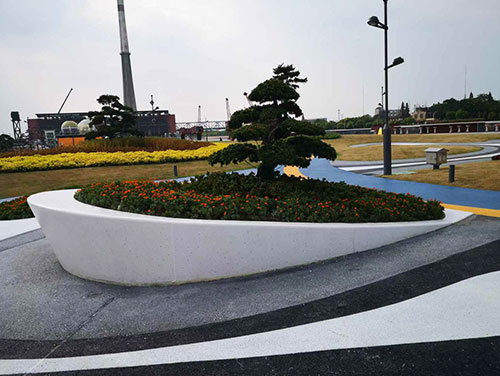
The exceptional compressive strength of UHPC allows the flower bed panels to withstand soil pressure, plant root expansion, impact loads, and outdoor use without deformation. This ensures long-term dimensional stability even when the planter is exposed to high moisture levels.
In many climates, outdoor materials must endure freezing temperatures, heavy rainfall, strong sunlight, or coastal wind conditions. UHPC is engineered to resist freeze–thaw cycles, chloride penetration, and surface erosion. The stone-look finish remains stable, retaining its texture and color over many years.
Unlike natural stone, which may require sealing or periodic restoration, UHPC has a dense surface that resists staining, water absorption, and biological growth. Cleaning typically requires only simple water rinsing or mild detergent, reducing long-term maintenance costs for property owners and municipal departments.
The high strength-to-weight ratio of UHPC allows flower bed elements to be manufactured with thinner walls while maintaining structural integrity. This reduces transportation costs and simplifies installation, especially in roof gardens, commercial terraces, or areas with limited load-bearing capacity.
UHPC flower beds can be produced in various shapes—including circular, square, linear, and polygonal forms—to fit different landscape layouts. Designers can adjust height, thickness, curvature, and panel textures to match project requirements. The modular approach supports flexible arrangement in public plazas or multifunctional outdoor areas.
The UHPC stone-look landscape flower bed is suitable for a wide range of outdoor projects, including:
In public squares and pedestrian areas, planter beds shape the spatial organization and guide pedestrian flow. UHPC elements provide a durable, vandal-resistant solution, especially in heavily used city centers.
Shopping districts, business parks, and hospitality facilities rely on outdoor landscaping to enhance the user experience. The textured stone appearance contributes to a high-end, cohesive atmosphere while providing functional planting areas.
Homeowners and residential developers appreciate the aesthetic of stone without the installation complexity. UHPC planter beds can delineate terraces, outdoor seating areas, and garden spaces while maintaining a minimalistic look.
In naturalized parks, botanical gardens, and recreational trails, the stone-look finish integrates well with the surrounding vegetation. Its resistance to weathering allows it to perform reliably for decades, even in humid or coastal climates.
Civic facilities, museums, and educational campuses often seek materials that combine architectural quality with public durability. UHPC flower beds provide clean lines, structural safety, and an eco-conscious alternative to quarried stone.
While UHPC is known for its engineered performance, it also contributes positively to sustainability goals. Its long service life reduces replacement frequency, lowering the environmental impact associated with material extraction and manufacturing. UHPC can also be produced with supplementary cementitious materials, reducing the need for traditional cement.
Additionally, modular planter bed systems encourage the integration of greenery into urban infrastructure, supporting biodiversity and improved air quality.
The installation of a UHPC stone-look landscape flower bed typically follows a straightforward process:
Site Preparation
The ground or foundation is leveled, and drainage systems are planned to manage excess water.
Panel Positioning
UHPC panels or prefabricated units are placed using lifting equipment or manual installation depending on size and weight.
Joint Treatment
Connections between panels may involve stainless-steel fasteners, concealed brackets, or structural adhesives.
Backfilling and Planting
Once the structure is secure, soil and plant materials are added. The dense UHPC structure prevents leakage and maintains shape under pressure.
Long-Term Monitoring
Maintenance is minimal, limited mainly to vegetation care rather than the planter structure itself.
This installation flexibility enables landscape designers to implement complex shapes or layered garden systems with efficiency.
One of UHPC’s strengths is its adaptability to project-specific needs. Customizable features include:
Stone textures: smooth, rough, stratified, or carved
Colors: earth tones, charcoal, limestone shades, warm beige
Panel size and thickness
Curved or angular shapes
Integrated seating or lighting features
These options give architects and landscape designers the freedom to create cohesive outdoor compositions that match modern architectural trends.
UHPC is engineered for long-term use, with service lives often exceeding several decades. Its resistance to micro-cracking ensures the stone-look finish remains intact even after extended exposure to temperature fluctuations. In coastal environments, the material withstands salt spray and moisture without corrosion or surface degradation.
This level of performance makes UHPC planter beds a reliable choice for municipalities, developers, and landscape firms seeking materials that minimize future replacement and repair costs.
The UHPC stone-look landscape flower bed represents a refined balance between natural beauty and advanced material engineering. By replicating the texture of stone while delivering superior durability, stability, and design versatility, UHPC offers landscape architects a resilient solution for modern outdoor environments. From urban plazas and public parks to private courtyards and commercial plazas, these planter systems support long-term landscaping needs while enhancing visual harmony within architectural settings.
As urban design continues to prioritize sustainability, longevity, and aesthetic coherence, UHPC stone-look flower beds provide a future-oriented approach to outdoor construction materials.
This website uses cookies to ensure you get the best experience on our website.

 Español
 Portugues
 Pусский
 Français
 Deutsch
 日本語
日本語 한국어
한국어 العربية
 Italiano
 Polski
 Türk dili
 Melayu
 中文
中文 қазақ
қазақ עִברִית
 українська
 norsk
norsk o'zbek
 ଓଡିଆ
ଓଡିଆ



 Phone
Phone