
Where Structural Strength Meets Ethereal Beauty
Our UHPC perforated panels shatter conventional perceptions of concrete:
Ultra-Thin Profile: Minimum thickness of just 8mm maintains structural integrity even at 60% open area ratio
Light-Transmitting Marvel: Optional light-guiding fibers or embedded LED systems create celestial light patterns at night
Parametric Precision: Supports complex cutouts (circles/fractals/custom designs) with 0.5mm accuracy
✓ Lightweight: Standard 15mm panels weigh ≤35kg/m², reducing structural loads
✓ Wind-Resistant: Special reinforcement ribs withstand 1200Pa wind tunnel testing
✓ Self-Supporting: 2m spans require no additional framing (EN 12467 certified)
Light Modulator: Adjust 20%-80% natural light penetration through aperture density
Dynamic Facades: Modular assembly creates "breathing" building skins
Acoustic Enhancement: Special perforation patterns achieve NRC 0.6 sound scattering
Technical Specifications
Parameter | Specification |
Max. Size | 3000×1500mm |
Standard Thickness | 12/15/20mm |
Cutout Tolerance | ±0.3mm |
Fire Rating | Class A1 Non-combustible |
▸ Grasshopper parametric design integration
▸ Infill options (laminated glass/acrylic/living plant systems)
▸ Surface finishes: Patina copper/mirror polish/sandblasted matte
Lightweight UHPC Perforated Decorative Panels: Comprehensive Architectural Guide
Modern architecture increasingly demands façade solutions that blend aesthetics, functionality, and structural performance. Lightweight UHPC (Ultra-High Performance Concrete) Perforated Decorative Panels offer a solution that combines advanced material technology with innovative design. These panels provide exceptional durability, corrosion resistance, and long-term stability while allowing creative perforated patterns that enhance light, ventilation, and visual interest. Suitable for commercial, residential, and public projects, Lightweight UHPC perforated panels enable architects and engineers to achieve visually compelling, sustainable, and high-performance façades without compromising structural efficiency.
UHPC is a premium concrete formulation characterized by high compressive strength, superior durability, and a dense microstructure. It typically contains fine aggregates, high cement content, silica fume, and chemical admixtures, achieving compressive strengths exceeding 150 MPa. UHPC’s low porosity reduces water absorption, minimizes cracking, and provides resistance to environmental stressors such as freeze-thaw cycles, UV exposure, and chemical attack. These properties make UHPC an ideal material for exterior and interior architectural panels that require long-term performance.
Perforated panels feature precisely engineered openings that provide functional and aesthetic advantages. Perforations enable natural light penetration, enhance airflow, and create dynamic shadow effects, contributing to both interior comfort and façade design innovation. Patterns can range from geometric shapes and linear motifs to organic or abstract forms, customizable to meet architectural vision, brand identity, or environmental conditions. Unlike applied decorations or coatings, the perforations are integral to the UHPC matrix, ensuring durability and minimal maintenance.
Lightweight UHPC panels are engineered with specialized aggregates or admixtures to reduce density while maintaining structural strength. This reduction in weight allows for larger panel dimensions, simplified handling, and reduced structural load requirements. The combination of strength and low weight facilitates innovative design, ease of transportation, and efficient installation, particularly in multi-story buildings or retrofitting projects.
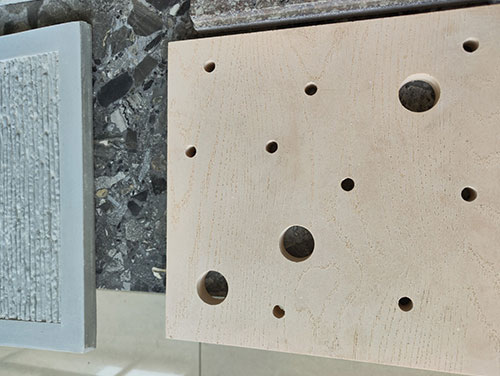
Despite reduced weight, these panels retain high compressive and flexural strength. UHPC’s dense microstructure provides resistance to impact, abrasion, and environmental degradation, including freeze-thaw cycles and chemical exposure. Lightweight UHPC panels offer long-term structural reliability, making them suitable for exterior façades, interior partitions, and architectural screens.
Perforated patterns enhance architectural creativity. Panels can be customized for intricate geometries, patterns inspired by nature, or abstract designs that create dynamic shadow and light effects. Integral coloring, surface finishing, and texturing allow for consistent aesthetic quality, supporting design continuity across façades and interior spaces.
UHPC’s low porosity and dense matrix provide exceptional resistance to water, corrosion, UV exposure, and extreme temperatures. This ensures that panels maintain structural integrity and appearance over decades, even in harsh climates or industrial environments, reducing lifecycle maintenance costs.
Compared to traditional concrete or stone panels, lightweight UHPC panels reduce structural loads and simplify installation. Larger panel spans are feasible without additional structural reinforcement, enabling creative façade designs. Lightweight panels also reduce labor and transportation costs, making construction projects more efficient.
UHPC panels offer long-term sustainability benefits. Their durability reduces the need for replacement and repair, while lightweight design minimizes transportation energy consumption. Panels can incorporate recycled aggregates or industrial by-products, contributing to environmentally conscious construction practices. Minimal maintenance, such as periodic cleaning and sealant inspection, ensures panels retain aesthetic and structural performance over their lifecycle.
Panel thickness typically ranges from 20 mm to 50 mm, depending on perforation density, pattern complexity, and structural requirements. Engineering calculations consider panel weight, environmental loads, and anchoring requirements to ensure stability and safety.
Perforation design requires balancing aesthetic goals with mechanical performance. Hole diameter, spacing, and pattern density affect light transmission, ventilation, acoustic properties, and structural integrity. CAD (Computer-Aided Design) and FEA (Finite Element Analysis) are commonly used to optimize perforation designs for both performance and visual impact.
Panels are typically installed using concealed brackets, mechanical fasteners, or hybrid anchoring systems. Proper anchoring ensures structural stability while accommodating thermal expansion and building movement. Engineering specifications account for panel size, perforation density, wind load, and seismic activity.
Perforated UHPC panels can enhance building performance when integrated with insulation or ventilated façade systems. They allow natural airflow, reduce artificial lighting needs, and moderate sound levels. Perforations help diffuse noise and contribute to acoustic comfort in interior or semi-outdoor spaces.
Proper installation is critical for safety and long-term performance:
Structural Assessment: Verify that supporting frameworks meet load-bearing and environmental requirements.
Panel Handling: Use cranes or lifting equipment with protective straps; store panels flat, dry, and secure.
Anchoring: Install panels with engineered fasteners or brackets that allow for thermal expansion and proper load distribution.
Joint Sealing: Apply high-quality sealants between panels to prevent water and air infiltration.
Inspection: Confirm alignment, surface integrity, and anchor security after installation.
Routine maintenance ensures durability and appearance:
Surface Cleaning: Use low-pressure water or neutral pH cleaners to remove dirt and pollutants; avoid abrasive or acidic cleaners.
Sealant Monitoring: Inspect joints periodically to maintain water and air tightness.
Structural Checks: Monitor anchors and fasteners to ensure panels remain secure and aligned.
Minimal maintenance ensures long-term performance with reduced lifecycle costs.
Lightweight UHPC perforated decorative panels are suitable for diverse architectural projects:
Commercial Buildings: Office towers, hotels, and shopping centers benefit from lightweight, durable, and visually engaging façades.
Residential Developments: Apartments and high-end homes utilize perforated panels for aesthetic appeal, ventilation, and natural light modulation.
Public Infrastructure: Museums, libraries, and cultural centers incorporate panels for dynamic façades, sustainability, and low maintenance.
Interior Feature Walls and Partitions: Panels provide decorative screens, light modulation, and acoustic control within interior spaces.
Corporate Headquarters, Germany: Panels enabled lightweight, large-span façades with geometric perforations, reducing structural load while enhancing aesthetics.
Residential Tower, Canada: Custom perforated panels improved natural ventilation and daylighting, enhancing occupant comfort.
Cultural Center, USA: Panels provided durable, low-maintenance façades with integrated perforation designs for light modulation and visual interest.
These projects illustrate the versatility, performance, and design potential of lightweight UHPC perforated panels.
Lightweight UHPC Perforated Decorative Panels provide architects and engineers with a high-performance, durable, and visually compelling solution for modern façades. Combining UHPC’s structural strength and corrosion resistance with innovative perforation designs, these panels offer long-term reliability, aesthetic versatility, and functional benefits such as light modulation and ventilation. Lightweight construction simplifies installation, reduces structural load, and supports sustainable building practices. Suitable for commercial, residential, and public projects, UHPC perforated panels enable façades that are functional, dynamic, and resilient, ensuring enduring architectural appeal in demanding environments.
This website uses cookies to ensure you get the best experience on our website.

 Español
 Portugues
 Pусский
 Français
 Deutsch
 日本語
日本語 한국어
한국어 العربية
 Italiano
 Polski
 Türk dili
 Melayu
 中文
中文 қазақ
қазақ עִברִית
 українська
 norsk
norsk o'zbek
 ଓଡିଆ
ଓଡିଆ



 Phone
Phone