
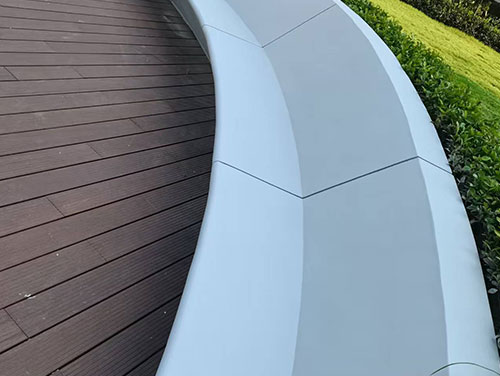
Landscape benches and art pieces crafted from Ultra-High Performance Concrete (UHPC) redefine the durability and design possibilities of outdoor furniture. With exceptional compressive strength (150-250 MPa) and an almost zero-porosity structure, these products remain stable in harsh environments—resisting freeze-thaw cycles, extreme heat, and salt spray—while avoiding the cracking and degradation common in traditional concrete.
Thanks to UHPC’s advanced properties, we achieve ultra-thin designs (as slim as 3 cm) that are impossible with conventional stone or standard concrete. The result is a modern, weightless aesthetic, whether in sharp geometric benches or fluid sculptural forms, all while maintaining structural integrity.
Every UHPC piece can be tailored in texture—from exposed aggregate roughness to smooth, polished finishes, from rust-like metallic effects to semi-translucent light-transmitting designs (with optional embedded LED lighting). Precise pigmentation allows for everything from natural earth tones to bold, high-saturation colors, ensuring seamless integration or striking contrast within any landscape.
UHPC far outlasts conventional landscape materials, with a lifespan exceeding 50 years and minimal maintenance. Its UV resistance, graffiti-proof surface, and scratch resistance make it ideal for high-traffic public spaces. Prefabrication reduces on-site construction waste, aligning with sustainable design principles.
We provide end-to-end technical support from concept to installation:
Parametric design optimization for complex geometries
Structural simulations ensuring safety (static load capacity ≥500 kg)
Modular prefabrication for rapid on-site assembly
Structural Innovation
Cantilevered designs with integrated stainless steel reinforcement
Hollow cavities with hidden drainage channels
Functional Enhancements
Optional wireless charging or heated seating systems
Modular configurations for flexible layouts
Signature Applications
Historic district revitalization (sandstone-textured benches)
Coastal wave-shaped seating resistant to salt erosion
Custom-branded art installations for commercial developments
High-Strength UHPC Acid-Washed Effect Panels: A Detailed Architectural Guide
Modern architecture requires façade materials that provide both aesthetic appeal and long-term performance. High-strength UHPC (Ultra-High Performance Concrete) acid-washed effect panels combine advanced concrete technology with distinctive surface texturing, creating visually striking and structurally reliable cladding solutions. These panels offer exceptional compressive and flexural strength, durability under extreme environmental conditions, and minimal maintenance requirements. This article presents a comprehensive overview of high-strength UHPC acid-washed effect panels, covering material composition, performance characteristics, design considerations, installation practices, maintenance strategies, and their applications in contemporary architecture.
UHPC is a specialized concrete formulation designed for superior mechanical performance and long-term durability. Its composition typically includes fine aggregates, high cement content, silica fume, and chemical admixtures, resulting in compressive strengths often exceeding 150 MPa. The dense microstructure significantly reduces water absorption, enhances resistance to freeze-thaw cycles, and minimizes cracking and chemical attack. These properties make UHPC particularly suitable for exterior applications and cladding systems subjected to harsh weather or urban pollution.
The acid-washed effect creates a refined, textured surface that mimics natural stone or exposed aggregate finishes. By treating the UHPC surface with controlled acidic solutions, the top layer is selectively eroded, revealing fine aggregates and producing a tactile, visually engaging texture. Unlike coatings or surface-applied finishes, the acid-wash is integral to the UHPC panel, ensuring long-term durability, color stability, and resistance to wear or fading.
High-strength UHPC acid-washed effect panels are primarily used in curtain walls, exterior façades, and decorative cladding. As non-load-bearing elements, they provide protective, weather-resistant surfaces while enhancing architectural aesthetics. The lightweight nature of UHPC allows larger panel spans and complex geometries without overloading the structural frame, enabling innovative façade designs.
These panels provide high compressive and flexural strength, making them resistant to mechanical stresses, impact, and environmental degradation. Their dense UHPC matrix prevents water infiltration, mitigating freeze-thaw damage, chemical corrosion, and surface erosion, ensuring long-term structural integrity.
The acid-washed effect produces a textured, refined surface that mimics natural stone or aggregate finishes. Architects can select varying degrees of texture, aggregate exposure, and color shading to achieve the desired visual impact. This versatility allows integration with both modern and traditional architectural styles.
Compared to traditional stone cladding, UHPC panels are significantly lighter, reducing structural load and simplifying handling and installation. This allows for larger panel dimensions, faster construction, and reduced labor costs, without compromising performance.
High-strength UHPC acid-washed panels withstand extreme environmental conditions, including rain, wind, UV exposure, and freeze-thaw cycles. The integral acid-washed surface maintains its texture and appearance over time, eliminating the need for protective coatings or frequent maintenance.
UHPC panels contribute to sustainable construction practices by reducing material consumption and extending building lifespan. Panels are low-maintenance, with surfaces resistant to staining, abrasion, and fading. The potential use of recycled aggregates and industrial by-products further enhances environmental benefits.
Optimal panel dimensions depend on aesthetic goals, structural support, and handling constraints. Thickness typically ranges from 20 mm to 50 mm, with larger panels requiring engineered anchoring systems. Proper dimensioning ensures stability while providing design flexibility.
The acid-washed effect can be customized to reveal varying degrees of aggregate exposure or subtle surface reliefs. Finishes may be matte, semi-polished, or textured, depending on architectural intent. Integral pigmentation ensures uniform coloration and UV resistance over time.
Panels are installed using mechanical fasteners, concealed brackets, or hybrid systems that allow for thermal expansion and movement. Engineering calculations should account for panel weight, wind loads, and seismic conditions to maintain safety and durability.
While primarily decorative, UHPC panels contribute to building performance. When integrated with insulation or ventilated façade systems, they enhance thermal efficiency and provide sound attenuation, improving indoor comfort in residential and commercial projects.
Proper installation ensures long-term performance:
Structural Assessment: Verify that supporting frameworks can handle panel weight and environmental loads.
Panel Handling: Use cranes or lifting equipment with protective straps; store panels on flat, dry surfaces.
Anchoring: Secure panels with engineered brackets or fasteners, allowing for controlled thermal expansion.
Joint Sealing: Apply weather-resistant sealants at panel joints to prevent water infiltration and air leakage.
Inspection: After installation, check alignment, surface integrity, and secure anchorage.
Although UHPC acid-washed panels are low-maintenance, routine inspection improves lifespan:
Surface Cleaning: Employ low-pressure water or neutral pH cleaners to remove dirt, debris, or pollutants. Avoid abrasive or acidic cleaners.
Sealant Checks: Inspect joints for wear or deterioration, particularly after extreme weather events.
Structural Monitoring: Confirm anchors and fasteners remain secure and panels maintain proper alignment.
Routine maintenance ensures the preservation of both structural and aesthetic qualities.
High-strength UHPC acid-washed effect panels are versatile, suitable for diverse projects:
Commercial Buildings: Office complexes, hotels, and retail centers benefit from durable, textured façades.
Residential Developments: Apartments and luxury homes achieve natural stone-like aesthetics without heavy material or maintenance challenges.
Public Infrastructure: Museums, libraries, and cultural centers gain long-lasting, visually appealing exteriors.
Façade Renovation: Existing buildings can utilize UHPC panels for aesthetic modernization, improved durability, and reduced lifecycle costs.
Real-world projects illustrate the advantages of UHPC acid-washed panels:
Corporate Headquarters, Germany: Panels provided durable, textured façades while meeting structural and environmental requirements.
Residential Tower, Canada: Lightweight panels allowed large spans without overloading the structure, simplifying installation and reducing labor demands.
Cultural Center, USA: Panels offered long-term weather resistance, minimal maintenance, and unique aesthetic appeal suitable for high-traffic public areas.
These projects demonstrate the panels’ functional and visual benefits in various architectural contexts.
High-strength UHPC acid-washed effect panels offer an ideal combination of structural integrity, durability, low maintenance, and distinctive aesthetic appeal. By integrating UHPC technology with a textured acid-washed surface, architects and engineers can create façades that are visually compelling, resilient under harsh environmental conditions, and environmentally responsible. Suitable for commercial, residential, and public buildings, these panels provide a sustainable, high-performance solution for modern architecture, ensuring long-lasting beauty and structural reliability.
 RELATED
This website uses cookies to ensure you get the best experience on our website.

 Español
 Portugues
 Pусский
 Français
 Deutsch
 日本語
日本語 한국어
한국어 العربية
 Italiano
 Polski
 Türk dili
 Melayu
 中文
中文 қазақ
қазақ עִברִית
 українська
 norsk
norsk o'zbek
 ଓଡିଆ
ଓଡିଆ



 Phone
Phone