
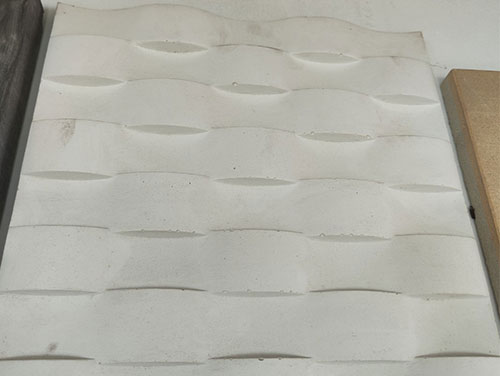
Using patented molding technology, we engineer millimeter-precise three-dimensional textures into UHPC surfaces—from rugged volcanic rock and handcrafted ceramic impressions to futuristic parametric reliefs. Every contour undergoes structural validation, ensuring artistic expression never compromises durability.
Tactile Innovation : Adjustable relief depth (0.2-15mm) for anti-slip functionality (static friction coefficient μ≥0.6) or pure artistic statement
Dual-Stage Craftsmanship : CNC-carved master molds → silicone transfers for edge fidelity → UHPC casting
Light Play Architect : Dynamic shadow patterns evolve with solar angles, giving facades a fourth dimension
Self-Cleaning : Open-texture design promotes rainwater runoff (60% less cleaning vs. smooth surfaces)
▸ Panel thickness: 8-50mm
▸ Texture accuracy: ±0.5mm tolerance
▸ Flexural strength: ≥18MPa (with deep textures)
▸ Weathering: Zero spalling after 300 freeze-thaw cycles
◈ Architectural cladding: Weightless alternative to dimensional stone
◈ Feature walls: Backlight-ready for dramatic shadow casting
◈ Urban furniture: Integrated anti-slip seating with wayfinding textures
Texture sourcing: 3D-scanned artifacts (heritage bricks/bark/fossils) or digital models
Functional hybrids: Texture grooves embedding snow-melt tubing or acoustic wool
Color interventions: Gradient dyes/metallic coatings (enhancing depth perception)
High Density UHPC Exterior Wall Texture Panels: Advancing Modern Building Performance
Ultra-High Performance Concrete (UHPC) has redefined the possibilities for modern architecture, particularly in the design and construction of exterior wall panels. Among UHPC applications, high density UHPC exterior wall texture panels stand out as a versatile solution that combines exceptional structural performance with aesthetic flexibility. These panels are increasingly integrated into contemporary building façades due to their ability to deliver durability, lightweight design, and surface customization, meeting both performance and architectural requirements.
This article examines the technical principles, material composition, manufacturing processes, and practical applications of high density UHPC exterior wall texture panels. It also explores market trends, quality factors, supply chain considerations, and emerging innovations in façade engineering.
The global construction industry faces mounting pressures to create buildings that are not only visually compelling but also sustainable, energy-efficient, and resilient. Traditional concrete and masonry solutions are often heavy, less versatile in form, and vulnerable to environmental degradation over time. Architects and engineers require materials that offer long-term durability, reduced maintenance costs, and design adaptability.
High density UHPC exterior wall texture panels address these needs. Their adoption is particularly evident in commercial office complexes, residential high-rises, cultural facilities, and public infrastructure. The demand is fueled by several factors:
Urbanization and high-rise construction requiring lightweight yet strong façade solutions
Prefabrication and modular construction trends, which favor panelized systems
Sustainability mandates emphasizing material efficiency and lifespan extension
Architectural creativity, where complex textures and large-format panels are desired
As global construction increasingly emphasizes sustainability and efficiency, high density UHPC panels offer a reliable solution for both aesthetic and structural demands.
High density UHPC exterior wall texture panels are engineered from a composite matrix that incorporates ultra-high performance cementitious material with dense aggregates and fine reinforcement. The high density ensures improved compressive strength, reduced porosity, and enhanced resistance to environmental stressors such as freeze-thaw cycles, wind loads, and moisture penetration.
Dense Cementitious Matrix
The compact particle packing in UHPC reduces voids, increasing mechanical strength and durability.
Micro-Reinforcement Fibers
Typically, steel or synthetic fibers are integrated to enhance tensile and flexural properties, minimizing cracking potential.
Surface Texture Engineering
Panels are molded or cast with customized textures—ranging from natural stone, wood grain, geometric patterns, to abstract designs—without compromising structural integrity.
These core principles enable panels to achieve both high-performance engineering standards and aesthetic versatility, which is critical in modern façade systems.
Typical high density UHPC panels consist of:
Portland cement or specialized high-strength cement blends
Fine aggregates, quartz sand, or silica powders for density and surface finish
Steel, polymer, or hybrid fibers for tensile reinforcement
Chemical admixtures for workability, curing control, and early strength development
Water in controlled proportions to maintain low water-to-cement ratio
High density UHPC panels are produced using precision-controlled processes:
Mixing – High shear mixers ensure uniform distribution of fibers and dense packing of aggregates.
Molding or Casting – Panels are formed in high-precision molds to achieve the desired surface textures.
Compaction – Mechanical vibration or pressurized casting ensures void-free panels.
Curing – Steam or temperature-controlled curing promotes optimal hydration, reducing shrinkage and enhancing durability.
Finishing – Surface treatments such as sandblasting, pigmentation, or sealants provide both aesthetic appeal and weather resistance.
Compressive strength exceeding 150 MPa
Flexural strength up to 40 MPa
Extremely low permeability, enhancing durability
High abrasion and impact resistance
Lightweight compared with conventional concrete, reducing structural load
Several critical factors affect panel performance:
Mix Design Accuracy – Particle size, fiber content, and water-cement ratio must be optimized for strength and workability.
Fiber Distribution – Uniform dispersion prevents localized weaknesses and ensures crack control.
Curing Conditions – Proper humidity and temperature control are vital for dimensional stability.
Mold Precision – High-fidelity molds are necessary for accurate textures and consistent panel dimensions.
Environmental Considerations – Coastal, freeze-thaw, or high UV exposure zones require additional material protection and surface sealing.
Professional engineering and rigorous quality control are essential to maximize the lifespan and performance of UHPC exterior panels.
Choosing the right UHPC panel supplier significantly influences project outcomes. Key evaluation criteria include:
Proven experience with high density UHPC products and large-scale façade systems
Laboratory capabilities for mix design and mechanical testing
Mold-making precision and digital fabrication capabilities
Consistency in curing and finishing processes
Engineering support for anchoring and installation solutions
Reliable logistics and delivery scheduling
A stable supply chain ensures uniform quality, timely delivery, and seamless installation, reducing potential project risks.
Despite the benefits, high density UHPC exterior wall panels present several challenges:
Panel Cracking – Caused by improper curing or uneven fiber distribution.
Surface Defects – Air voids or mold imperfections can impact aesthetic quality.
Installation Complexity – Requires precise anchoring and alignment to accommodate thermal movement.
Cost Considerations – Initial material and production costs are higher than conventional concrete, though lifecycle benefits offset these expenses.
Mitigation requires experienced engineers, precise manufacturing, and thorough quality control.
High density UHPC panels are applied across multiple building types:
Commercial Façades – Office towers and shopping centers benefit from lightweight, textured panels that reduce structural load.
Residential Projects – High-rise apartments and condominiums utilize UHPC panels for aesthetic façades with reduced maintenance.
Public Infrastructure – Transportation hubs, museums, and civic centers use panels for durability, weather resistance, and custom textures.
Modular Construction – Panels integrate seamlessly into prefabricated systems, enabling rapid installation and consistent quality.
Case studies indicate that high density UHPC panels improve building longevity, reduce maintenance costs, and allow architects to implement complex designs.
Several trends are influencing the evolution of UHPC exterior wall panels:
Digital Fabrication – CNC molds and robotic casting enable precise textures and large-format panels.
Sustainable Mixes – Integration of supplementary cementitious materials reduces carbon footprint and enhances durability.
Hybrid Panel Systems – Combining UHPC with insulation, metal frames, or other composites optimizes thermal performance and structural efficiency.
Fire and Safety Optimization – Research into fire-resistant UHPC enhances compliance with stricter building codes.
Prefabricated Façade Expansion – Modular construction relies increasingly on UHPC panels for both structural and aesthetic performance.
These developments highlight the growing importance of high density UHPC in next-generation façades and high-performance building envelopes.
1. What is the typical lifespan of high density UHPC panels?
Panels can last 50 years or more with proper installation and maintenance.
2. Are these panels suitable for coastal environments?
Yes, their dense matrix and fiber reinforcement provide strong resistance against salt and moisture exposure.
3. Can UHPC panels be used in seismic zones?
Yes, their high strength-to-weight ratio and crack resistance enhance performance in areas prone to seismic activity.
4. What textures are achievable?
Panels can be molded with natural stone, wood grain, geometric patterns, abstract forms, or custom designs.
5. Do these panels require special maintenance?
Routine inspection and sealing can extend lifespan, particularly in extreme weather or high-pollution environments.
High density UHPC exterior wall texture panels offer a unique combination of strength, durability, lightweight design, and aesthetic flexibility. By addressing structural, environmental, and architectural challenges, they are becoming a preferred choice for contemporary façades across commercial, residential, and public projects. With advances in digital fabrication, sustainable materials, and modular construction methods, UHPC panels are positioned to play a central role in high-performance building envelopes, supporting both functional resilience and innovative design expression.
 RELATED
This website uses cookies to ensure you get the best experience on our website.

 Español
 Portugues
 Pусский
 Français
 Deutsch
 日本語
日本語 한국어
한국어 العربية
 Italiano
 Polski
 Türk dili
 Melayu
 中文
中文 қазақ
қазақ עִברִית
 українська
 norsk
norsk o'zbek
 ଓଡିଆ
ଓଡିଆ



 Phone
Phone